From the site: Jux is the best showcase for your stories. Share words, photos and
videos with unprecedented ease and impact. Fullscreen on every screen.
I really like the look of this site. It's a fancy slideshow, and it looks good. I'm working on a presentation now--I'll embed it when it's ready.
I'll describe this site as a slideshow of videos, webpages, and text. Instead of sending a list of links or bookmarking sites for your students, create a MentorMob presentation, and the students can simply click from page to page. Even if you don't see yourself making one, check out the shows made by others.
Wow! This site is a collection of web tools. Many links. When folks do this much work, it's hard to complain about our own lack of ideas. Just click a few tabs and wait for an idea to pop into your head. Incorporating technology into our classrooms is ridiculously easy nowadays. It's fun and it grabs attention. Thanks to Tim Wilhelmus!
Dan Meyer, a high school math teacher, presents a humorous, intelligent argument on changing math instruction.
Teachers, we have to change something. We order them to memorize vocabulary, practice facts, remember steps and algorithms, and, yet, we're surprised when they can't solve new word problems. Why? We've not asked them to do math. Now, I'm not saying that those things aren't valuable, but there has to be more to math. Through thinking and collaboration and freedom and challenge, we can create mathematicians instead of frustrated robots.
"To start with, I'd like to break math down into two categories. One is computation; this is the stuff you've forgotten. For example, factoring quadratics with leading coefficients greater than one. This stuff is also really easy to relearn, provided you have a really strong grounding in reasoning. Math reasoning -- we'll call it the application of math processes to the world around us -- this is hard to teach. This is what we would love students to retain, even if they don't go into mathematical fields. This is also something that, the way we teach it in the U.S. all but ensures they won't retain it."
"So first, five symptoms
that you're doing math reasoning wrong
in your classroom.
One is a lack of initiative; your students don't self-start.
You finish your lecture block
and immediately you have five hands going up
asking you to re-explain the entire thing at their desks.
Studentslack perseverance.
They lack retention; you find yourself
re-explaining concepts three months later, wholesale.
There's an aversion to word problems,
which describes 99 percent of my students.And then the other one percent
is eagerlylooking for the formula
to applyin that situation.
This is really destructive" [emphasis added].
"I encourage math teachers I talk to to use multimedia,
because it brings the real world into your classroom
in high resolution and full color;
to encourage student intuition for that level playing field;
to ask the shortest question you possibly can
and let those more specific questions come out in conversation;
tolet students build the problem,
because Einstein said so;
and to finally, in total, justbe less helpful,
because the textbook is helping you in all the wrong ways:
It's buying you out of your obligation,
for patient problem solving and math reasoning, to be less helpful" [emphasis added].
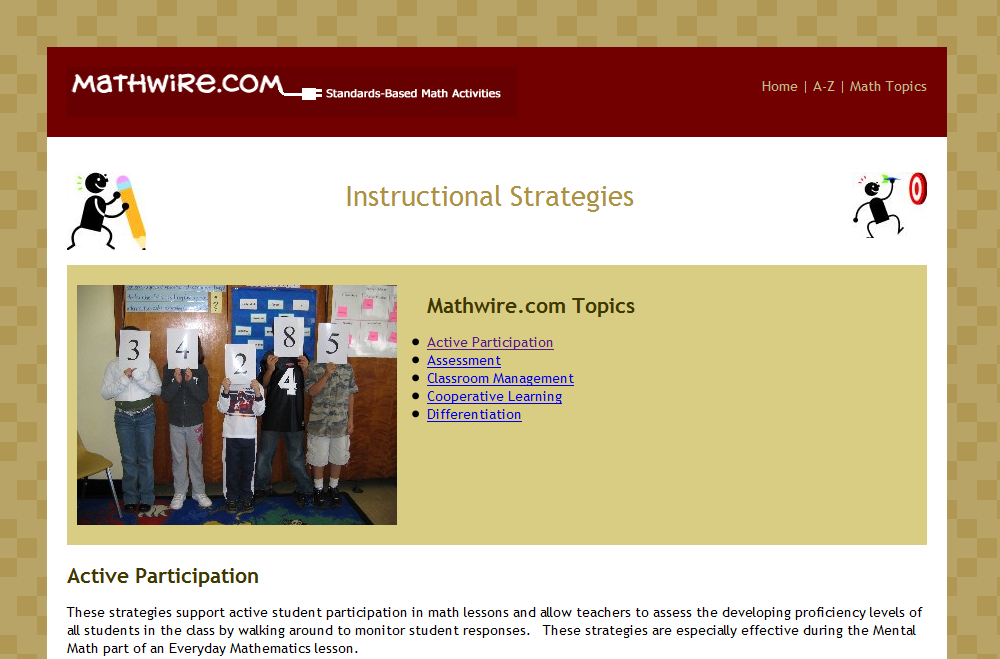
Don't let the name of the site fool you--it has several strategies and links for use across subjects. Below, you'll find the sections and explanations.
Active Participation
These strategies support active student participation in math lessons and allow teachers to assess the developing proficiency levels of all students in the class by walking around to monitor student responses. These strategies are especially effective during the Mental Math part of an Everyday Mathematics lesson.
Assessment Assessment takes many different forms in today's math classroom. Teachers who maximize active student participation in lessons also maximize assessment opportunities. Assessment must both diagnose student strengths/weaknesses and inform instructional decision-making. Good assessment practices provide information on student conceptual/skill development as well as information on the effectiveness of instructional activities and grouping practices.
Classroom Management These resources offer practical suggestions to help teachers organize classrooms and implement practices that help students achieve both academic and personal success.
Cooperative Learning Teachers must use flexible grouping practices to best address the varied needs of students in a heterogeneous classroom. Over the course of a lesson or a unit, successful teachers break from whole-class instruction to require students to work as partners or small groups, making students more actively involved and responsible for their own learning.
Differentiation Differentiating instruction recognizes that today's classrooms are comprised of students of varied ability levels, interests and capacity for independent work. The regular use of differentiated instruction recognizes these differences and targets instruction, activities and flexible grouping practices to more effectively meet the needs of each student in a heterogeneous class.
From the site: Whether you call them math notebooks or math journals, writing about math and documenting math activities are a great way to cement mathematical understanding.
And along the way, you're creating a wonderful record of your math
studies that can be useful for portfolios or homeschool evaluations.
"Paula - A teacher in New York was teaching her class about bullying and
gave them the following exercise to perform. She had the children take a
piece of paper and told them to crumple it up, stamp on it and really
mess it up but do not rip it. Then she had them unfold the paper, smooth
it out and look at how scarred and dirty is was. She then told them to
tell it they’re sorry. Now even though they said they were sorry and
tried to fix the paper, she pointed out all the scars they left behind.
And that those scars will never go away no matter how hard they tried to
fix it. That is what happens when a child bullies another child, they
may say they’re sorry but the scars are there forever. The looks on the
faces of the children in the classroom told her the message hit home."
This site offers four different games that use muffin tins. They're designed for Language Arts lessons, but I think muffin tins are a great idea for other subjects.
"A study out of Harvard, conducted by the economist Raj Chetty, found that those placed in kindergarten classes run by more experienced and better teachers not only were more likely to perform well in later grades, but also were more likely to graduate high school, enroll in college, earn more and save more for retirement. A good teacher, defined by Eric Hanushek of Stanford as landing in the 84th percentile in quality, could add between $22,000 and $46,000 to a student’s lifetime earnings."
Because of this, some reformers support merit pay systems, which link pay raises and promotion with evaluations. Some folks from Harvard, University of Chicago, and UC San Diego have offered the results of their study.
"The authors split teachers in the study into a control group, who were
not offered any rewards, a 'gain' group, which was promised rewards of
up to $8,000 at the end of the school year, and a 'loss' group, which
was given $4,000 upfront and asked to pay back any rewards they did not
earn. The idea behind the latter group was that loss aversion should
motivate teachers to perform better than they would if they only stood
to gain more money. Additionally, the gain and loss groups were split,
with a 'team' group being rewarded on the basis of theirs and fellow
teachers’ test scores, and the “individual” group being reward only on
the basis of their own scores. The conclusion: it worked, and it worked
almost twice as well when the money was given at the start and then
taken away."
Of course it worked twice as well. If you gave me $4000 up front, I'd spend it immediately on glue sticks, pencils, and video games--I'd not have it to give back. Seriously, a $4000 "pay raise" would immediately improve motivation and satisfaction. Next time, they could try $20,000 and watch the teachers work some real magic.
"Now, in studies that threaten to shake the foundation of high-stakes
test-based accountability, Mr. Stroup and two other researchers said
they believe they have found the reason: a glitch embedded in the DNA of
the state exams that, as a result of a statistical method used to
assemble them, suggests they are virtually useless at measuring the
effects of classroom instruction...
"Pearson, which has a five-year, $468 million contract to create the
state’s tests through 2015, uses 'item response theory' to devise
standardized exams, as other testing companies do. Using I.R.T.,
developers select questions based on a model that correlates students’
ability with the probability that they will get a question right...
"This is not first time the use of standardized test scores in Texas has
been questioned. In 2009, the state implemented the Texas Projection
Measure, a formula that critics said allowed schools to count students
as passing who did not. After outcry from lawmakers, the state dropped
the measure in 2011."
This is heavy stuff. There's more to the article, so I hope you'll read it.
To up our game, teachers, I think we absolutely need to consult the Bloom Taxonomy when preparing lessons, activities, quizzes, etc. We can't rely on fill-in-the-blank for assessments and assignments. To improve our prestige, we have to expect more of ourselves and our students.
I did not dive too deep, but it looks fun. My link will take you to the videos and activities on flight, but you can check out the rest of the site for other videos and topics.
My teammates and I tried portfolios two years ago. It didn't go well. But, to be honest, I left too much to the students and didn't guide them enough. Since I do a lot of projects on the computers, an electronic portfolio is an interesting idea.
This article gives several helpful ideas about them, including steps, types, and reasons for using them.
Despite the incredible accomplishment of writing a published book, many comments--aimed at Mr. Goyal and education--were negative. I just had to write my own.
Good grief, people, he didn't raise taxes or shoot your dog--he wrote a
book. Fox Business invited him on their show, asked the questions they
wanted to ask, and rushed him out. To criticize him for not sharing more
ideas and painting a picture for you in the time that he had is
ridiculous. Are we under the impression that he wrote a coloring book?
I'm sure his ideas are described in detail.
How does the system improve without a drastic paradigm shift? I'm not
talking about reforms and the next best thing. "No, that's crazy. Test
the students. Fire the teachers. Cut budgets. Offer choice. It'll
work!!" We can't tinker with the system--we have to overhaul it. Mr.
Goyal made an excellent point--we have to reinvent the teaching
profession...
Teachers and some posters of comments love to make excuses, searching
high and low for reasons why we shouldn't change. They blame class-size,
parents, schedules, standardized tests, curricula, etc. Yes, some of
those things can hinder teaching, but they exist. I've noticed that many
teachers complain because change means... well, change and an end to
comfort. It's a new world, a new culture, new families, new
technologies, and, most importantly, a new breed of student. Several
countries understand this, so they made changes, from the top down, and
settled in for a long process. Unless we're happy with the present
system, the United States needs to rethink everything.
To raise the prestige of teachers, the universities need to be more
selective, more rigorous, and more practical. With higher prestige, the
relationships between parents and teachers will gradually improve. Also,
the profession will feel like a profession, and teachers will find
their hearts again, which greatly benefits the students. Schools need
autonomy--they need to make independent decisions for their students,
teachers, parents, and community. Teachers need to collaborate, creating
lessons together and observing one another. Ideas shouldn't come from
district "specialists." Formative assessments, differentiation, and
feedback need to saturate a teacher's classroom. And, unfounded plans
like NCLB and R2T need to disappear... It's easy to find success in other countries, in certain districts, and
at certain schools. Instead of embracing that success and emulating it,
we just point to differences. Or we criticize a 17 year old. That sucks,
folks. The administration and many Americans are way off point on
education. High-stakes standardized tests, rewards and punishments,
competition for money, choice... none of these are going to work. They
haven't and they won't. Defeatism and excuses won't work. Blaming
parents, students, teachers, and schools won't work. Posting a negative
comment at the Huffington Post won't work. Ignoring the research won't
work.
So, in my classroom (fifth grade, fifteen years), I decided to stop
making excuses. If I want my students to succeed and my parent-teacher
relations to improve, I have to change, grow, communicate, relate, and
facilitate. It's true... education can get messy, but it's a heck of a
lot of fun, and it's worth it. If I ever get to the point that it's not,
I need to move on. In the meantime, teachers, we need to fall in love
with teaching again, enjoy the students again, and create the greatest
classrooms--change will have to happen from the inside out.
"Under the federal No Child Left Behind law, all students should have a highly qualified teacher, and all school districts must inform parents which teachers are not highly qualified."
I would argue, according to common sense, all students should have a highly qualified teacher.
"According to the Department of Education, to be deemed highly qualified,
teachers must have a bachelor’s degree, full state certification or
licensure and prove that they know each subject they teach."
I know that I'm just playing with semantics here, but a degree, a certification, and knowledge really just describe characteristics of a qualified teacher. Shouldn't you have to earn the adverb after a length of time and positive evaluations?
"The proposed legislation [from a U.S. House appropriations subcommittee], if approved, would ensure that teachers in
training meet the “highly qualified” standard. This includes recent
college graduates attending Teach for America’s five-week summer
training institute."
Hey, now, I've taught for 15 years, and I wouldn't consider myself "highly qualified." I might be "enthusiastically qualified." Whatever that means. I continue to adapt and change and educate myself. TFA teachers train for five weeks. After my first degree, I still went back to school for two years. I spent my last year in the classroom, observing, completing grunt work, writing lesson plans, leading small groups, and working my way up to whole-class instruction. Five weeks?! And that's highly qualified?!
When TFA fails to perform miracles, be sure to blame all teachers, look for ways to offer ignored choice, praise charter schools for nothing, attach more consequences to those ill-conceived laws and their standardized offspring, and systematically destroy our public school systems. Morons.
When my wife gets home, I'm going to try this today. I thought it would be interesting for teacher-to-teacher questions during the day. Another idea hit me, though. Parent communication. Once in a while, a parent isn't able to appear in person, and requests a phone call. A video call is somewhere in the middle, I think.
Here's what I like: there's nothing to download. It's all web-based. Just shoot an e-mail to the other person and set a time or talk instantly. Cool.
"Michael Fullan is professor emeritus at the Ontario Institute for
Studies in Education of the University of Toronto, and is currently
special advisor to the premier and minister of education in Ontario."
In addressing improvements to education, Professor Fullan wrote, "Unfortunately some countries in a hurry to address the issues get
the solutions wrong. I call these mistake 'wrong drivers for whole
system reform'. Drivers are policy and strategy instruments designed to
'cause' improvement in the system. A wrong driver is one that does not
work; a right driver is one that does produce improvement. In our work
on system reform we have been sorting out what drivers work and which
ones do not. This is our conclusion: excessive accountability,
individualistic strategies designed to increase human capital,
technology and ad hoc policy solutions waste valuable time and resources
and often make matters worse. By contract emphasizing capacity building, collaboration and teamwork, instruction or pedagogy, and systemic
coherent policies do work. The key is which policies end up 'motivating'
teachers and others to put in the effort to get better results, while
at the same time serving the public accountability requirement that
practices and results are getting better, and that interventions are
occurring that actually address the problems in a productive way...
"But our approach and results as well as progress in other countries
using similar policies raises the direct question of how can the US
re-configure its approach at the state and Federal levels in order to
increase performance on a wide scale. The good news is that this can be
done, and that in can be done in a relatively short time --5 or 6 years
to make substantial progress. Time is of the essence in getting started
down this more productive path...
"Ontario public schools follow a model embraced by top-performing
hospitals, businesses, and organizations worldwide. Specifically, they
do five things in concert -- focus, build relationships, persist,
develop capacity, and spread quality implementation...
"By focusing on teacher development, Ontario was also able to raise
teacher accountability. Decades of experience have taught Canadian
educators that you can't get greater accountability through direct
measures of rewards and punishments. Instead, what Ontario did was to
establish transparency of results and practice (anyone can find out what
any school's results are, and what they are doing to get those results)
while combining this with what we call non-judgmentalism..."
Much more was written. And there are responses from some Canadian teachers.
15 Free Awesome Drawing and Painting Tools for Teachers and Students
From the site: To help teachers and educators cultivate this skill and improve students
critical thinking processes using drawing , I have compiled a list of
some of the best free drawing tools that can be used very easily and
most of the time without even registration or any software download.
From the site: Pics4Learning is a safe, free image library for education. Teachers and students can use the copyright-friendly photos and images for classrooms, multimedia projects, web sites, videos, portfolios, or any other project in an educational setting.
I know, teaching the students how to cite photos is important, but this type of site is perfect for a quick need.
Love this. Some--scratch that--many of my fifth graders have such trouble with place value, value, and expanded form. With folded paper, you can only create one number. With the cups, though, you can create several cups and use them interchangeably.
"Thirty-four states have slashed their K-12 education budgets since 2008, according to the Center on Budget and Policy Priorities. Making sure class sizes don't explode nationwide would cost $10 billion annually, according to a March report from the Southern Regional Educational Board."
I understand that Education is expensive, and I appreciate the need to balance budgets and prevent overspending. But, when did we stop believing that the future of our country rests with our children and their education? Now, it's all about the money.
"Likewise, teachers in McAllen, Texas, reported having 50 students in their classes this year, and a Las Vegas kindergarten teacher had 41 kids. According to the National Education Association, there are as many school jobs now as there were in April 2005 -- but 300,000 more students."
So, budget's are decimated; teachers are fired, and classes are bulging. As a result, teaching is less efficient and less personal. That's a logical consequence. Those who deny the negative consequences of large classes have made money a priority of their lives.
"Mitt Romney, the Republican candidate for president, has criticized the president for sending money to the states for such purposes. 'He wants another stimulus. He wants to hire more government workers,' Romney said last month at a press conference. 'He says we need more firemen, more policemen, more teachers. … It's time for us to cut back on government and help the American people.'"
Last I checked, firemen, policemen, and teachers are American people. Every job is important. Everyone plays a role in our society. Some help build profits more than others, though. Now, I'm not saying that those three professions are more important than others--it just seems that it's become too easy to minimize their importance and pound them with budget cuts.
A comment from LaReinadelaSuerte: Let's talk numbers. Most Jr. High and High School teachers are assigned 6 classes a day to teach, some have 7. If there are 30 students in each class, that comes out to 180 papers to grade per day. If the teacher takes 3 minutes to grade each paper, that comes out to 540 minutes or 9 hours. If a teacher decides to give each student 3 grades per week, the total hours per week dedicated to grading comes out to about 27. Grades then have to be input into a computer program or grade book, averaged at some point, etc. This is time consuming but important work. Math and English teachers probably grade more papers than 3 per week and on many assignments, like essays for example, take more than 3 minutes to grade them because written correction is needed. Larger class sizes force teacher to greatly reduce the amount of individual feedback they can give students. 40 hours (at least) at school per week + 27 hours for grading (at least) = 67 hours (at least) Would you put in these hours plus take everybody's abuse and be on your feet all day for $38,000/year? Teachers usually also have children of their own and would like to see them on a daily basis.
This blog post addresses the words of Chris Cerf, the commissioner of education in New Jersey. She speaks to his support of charter schools. In her blog, Ms. Ravitch states that charter schools could be successful... if they take the form of Albert Shanker's original idea.
"You can fix the charter idea if you align it with Shanker’s original idea.
"First, insist that all new charters are endorsed by the local school district and the union representing teachers.
"Second, bar all for-profit management.
"Third, insist that all charters recruit and enroll only the
lowest-performing students, the students who have dropped out, and the
students who are doing poorly in their present public school.
"Fourth, require that charters collaborate with the public schools and share whatever they learn.
"Fifth, to truly revive the spirit of Shanker’s proposal, bar all
corporate-owned charter chains. Authorize only stand-alone charters that
are created by teachers and parents in the district to serve the
children of that district. No chains, just local charters committed to
that community."